You have a marketing plan. A cash flow forecast. Maybe a business continuity plan gathering dust somewhere. You’ve planned for slow seasons, difficult clients, and market shifts.
But do you have a founder mental health and business plan?
If you’re like most women founders I work with as The Entrepreneurs’ Therapist™, the answer is no. But that’s not your fault. Nobody told you that caring for your mental and emotional well being was part of the entrepreneur’s job. The entrepreneurship world handed you templates for revenue projections and content calendars, but left your psychological well being out of the project.
In 2021 I developed the Entrepreneur Mental Health Business Plan for an incubator in San Diego, as a tool for entrepreneurs who need to track and evaluate their mental health as part of their business plans and processes. I’ve since delivered it in entrepreneurship programs and conferences throughout the US and Canada.
Here’s what I know after years of working as a therapist for founders and entrepreneurs, and running my own businesses: mental health challenges aren’t a side effect of entrepreneurship. They’re inherent in it. They’re an integral part of the work. The isolation, the financial uncertainty, the identity entanglement, the relentless decision-making… these are structural features of founding and running a business.
Mental health challenges are a risk inherent in entrepreneurship.
And in business, we plan for risk.
Resilience isn’t a personality trait you either have or you don’t. Resilience doesn’t happen by magic. It’s not something the “right” founders were born with while the rest of us are scrambling to keep up. The essence of resilience — both personal resilience and business resilience — is being resourced and prepared.
You are your business’s most valuable asset. A mental health plan is a core business strategy. It’s risk management, and it’s the most important business plan entrepreneurship training overlooks.
This guide will show you how to make that plan and use it.
What are Key Performance Indicators for Entrepreneur Mental Health?
Key performance indicators (KPIs) are quantifiable metrics used to assess how effectively key objectives –in this case for entrepreneur mental health–are being met. They are used in organizations to track the achievement of key business objectives. KPIs include both lag and lead indicators.
In this blog post you will learn about the two categories of lead indicators for entrepreneur mental health: those over which you have little to no control, and those over which you do have control. You will also learn how to identify your lag indicators, in other words, the indicators that you are doing poorly or well.
Here’s a type of scenario from which these terms arose.
Imagine the 1950s salesman. He wears a suit with a skinny tie and fedora. He goes to work in a room full of other salesmen at tables with phones, making calls and checking names off a list. He sits down at his desk; his list and his phone are there. He knows that he has to call this list of 100 prospective customers in order to make one sale. Making 100 calls is his lead indicator. It’s the action he has to take. The one sale is his lag indicator. It’s the outcome of the actions he took.
Let’s talk about how this applies to you and your mental health as a founder or business owner.
What are lead and lag indicators for entrepreneur mental health?
Lead indicators for entrepreneur mental health look forward; they are measurable actions that lead to outcomes. In relation to founder mental health and emotional well-being, lead indicators include self and communal care as well as the external conditions you experience, in other words, what’s happening in your life and in the world.
External conditions are, in the majority, out of your control. Self and communal care are usually in your control. In this category are also actions or behaviours that you know will have negative consequences, but you do anyway.
Lag indicators signal your current state of mental and emotional (and sometimes physical) well being. These are unique to every person. Lead indicators are the tactics, strategies and behaviours that will affect or have affected your current state.
You can use these concepts to help you assess your mental and emotional well-being and make a plan to protect and enhance them.
In my work as a therapist for entrepreneurs, I’ve identified 7 Factors of risk to entrepreneur mental health that show up most frequently in the work that I do with clients. These 7 Factors are one element of the lead indicators in a mental health plan. They outline the external conditions entrepreneurs experience that are out of their control and have a detrimental effect on founder mental health and emotional wellbeing.
The second type of lead indicators are those which are in your control. That’s where the three principles of stress resilience come in as the second element of your plan.
How do you put your entrepreneur mental health business plan together?
There are two steps in the process of compiling your entrepreneur mental health business plan: identifying your lead indicators for entrepreneur mental health, and then doing the same for lag indicators.
Step 1: How do you identify lead indicators for entrepreneur mental health
To identify lead indicators for entrepreneur mental health, first consider the three principles of stress resilience. Answer the following questions for each of the three principles for stress resilience:
· What activities are you already doing to soothe, discharge and nourish your nervous system?
· What did you used to do that soothed, discharged and nourished your nervous system that you enjoyed but are no longer doing?
· What is a teeny tiny doable action, strategy, tool or behavior that you feel like adding in?
I say ‘teeny tiny doable’ because we always have this idea that we should be doing this, that and the other thing. But those ideas and those kinds of aspirational lists undermine our mental health because they stress us out.
I’m inviting you to put one teeny tiny doable thing on your list so that you can actually do it and feel good about doing it.
Be sure to include communal care on this list—things you do to care for others and things you do, things that others do, that you allow them to do to care for you. This also includes activism to address the systems of oppression that are affecting your mental health and the mental health of other entrepreneurs like you.
It’s an important part of founder mental health and emotional well-being to be able to identify that, yes, some of this is out of your control, then identify the things that you can control, or over which you can exert some influence, and take action on that.
Engaging in activism, whatever kind of activism fits for you, is an important part of your stress resilience and an important activity in which to engage for your mental and emotional well-being as a business owner, entrepreneur or founder.
Next, consider the seven factors, the events that usually fall outside your realm of control.
Refer to the list to assess how each of these seven factors apply to your life. Determine how these factors affect you and which among them hold greater importance to you.
Step 2: How do you identify lag indicators for founder mental health
To identify lag indicators for entrepreneur mental health, consider that lag indicators measure what has happened after you implement or experience the lead indicators. They are the outcomes. They include your stress symptoms, your personal wellness indicators and indicators of health in business and your personal life.
In other words, lag indicators tell you:
· Am I showing up the way I want to?
· Is my business going the way I want it to?
· Is it showing the results that I want?
Stress symptoms are how your body feels, the kinds of things that affect your body and executive functioning and how you are impacted by stress.
Personal wellness indicators are signs that tell you when you’re doing well.
As we’ve discussed, when you find yourself breaking down, in truth, there’s really nothing wrong with you.
Breaking down can be considered a good thing because it’s a signal to look under the hood. It’s data. It’s a lag indicator. It’s important to know what’s happening so you can intervene with care and choice.
Brainstorm your lag indicators and make notes about them, so that you can become familiar with the signs that tell you you’re doing well, as well as the signs that tell you that you’re heading down a path where your mental and emotional well-being might be taking a hit.
These questions can guide your brainstorming.
How do you know you’re stressed?
When you’re breaking down:
o What is happening in your body?
o What is happening in your mind?
o How is your mood?
o What feedback are you getting?
o What are you doing?
o What are you not doing?
What tells you you’re doing OK?
When you’re feeling good:
o What is happening in your body?
o What is happening in your mind?
o How is your mood?
o What feedback are you getting?
o What are you doing?
o What are you not doing?
How do I use my Entrepreneur Mental Health Business Plan?
To use your entrepreneur mental health business plan, it’s first important to understand its purpose in order to use it effectively.
Your mental health plan does not prevent you from having a hard time. It identifies strategies you can use to care for yourself in an ongoing way. We don’t resource ourselves in order to feel good. Being resources, in other words, doesn’t mean you won’t feel bad. We resource ourselves in order to be able to hang in there through whatever is tough, in a good way, instead of gritting our teeth. And let’s be honest, despite the glorification of the freedom and flexibility, entrepreneurship is often tough.
It’s a myth to think that we can avoid what it means to be human, which is to experience hard times and difficult emotions but caring for yourself in a systematic and ongoing way can mitigate the impact when you’re having a hard time.
The reason we care for ourselves is not to make the difficulties go away, but to give ourselves care when we’re having a hard time. It’s a way of being kind to ourselves, so that the brain can better direct the body’s energy in a way that brings the CEO-self back online, so that we can show up the way we want to in life and in business.
You can compare yourself to a marathon runner or another high-performing athlete. It can look like the individual wins the race, on an individual basis, by individual will and power alone, because you only see the actual race.
In fact, behind the scenes and before and after the race, athletes have a whole team working to support them: a chiropractor, massage therapist, doctor, nutritionist, coach, sports psychologist, etc.
For the mental health plan, part of our work is building a team not only of practitioners, but also of strategies and tactics that support our mental and emotional well-being.
That’s what your plan is for: to help you be resilient. In other words, to put in place the skills and the supports that you need to care for yourself when the crap hits the fan.
The biggest challenge, as it is with all long-term projects, all plans that you make, is implementation support and accountability.
It doesn’t really matter if you create the formal plan (as I’m going to discuss in a moment). What really matters is doing the thing. It’s implementation that matters, and how better to implement than to have support and accountability?
Formats for using your Entrepreneur Mental Health Business Plan
The simplest application of your mental health plan is to include your mental and emotional well-being in discussions with your supportive others. You can add a check-in on your lead and lag indicators into your meetings with your coach or your mastermind group, for example, or your biz bestie. That can help you stay accountable.
To add to these peer discussions, you can follow this enhanced format, including the following questions when you are having conversations with supportive others:
- What’s working with your lead and lag indicators?
- What isn’t working?
- What are you learning from that information? (the information about what isn’t working)
- What are you going to change in light of what you’ve learned above?
The answer to question four becomes part of your lead indicators for the next period. It’s what you assess. You look at: did it work or didn’t it work? If so, what did I learn from that? And what am I going to do differently?
This is a very simple but enhanced way, once you know what your lag and lead indicators are, that you can incorporate an on-the-fly review when you’re talking to other folks.
Strategic Format for Ongoing Entrepreneur Well-being: assess, review, and plan
Assess
Assessing means noticing the performance of lag indicators in relation to the lead indicators. What’s going on around you? Which of the seven factors were at play this week? Did you or didn’t you implement your three principles of stress resilience? And how are you feeling? How’s your mood? How is your executive functioning? How are your symptoms? Take stock of all these things to see where you are now and why.
Review
Next, review what worked and what didn’t work. Some of the things that we encounter are out of our control, but they still have an impact, either negative or positive. Some strategies we use may have seemed like a good idea at the time but in the end they didn’t have the impact you intended. Sometimes you encounter surprises, things that had a positive influence that you can use again.
Plan
After that, you make a plan. Ask yourself: can I change anything, or will I change anything as a function of what I’ve learned above? Make a plan for what you’re going to do based on the information from the assessment and the review.
Over time, you will need to adapt your founder mental health plan for continued relevance.
As part of your regular strategic planning, it’s important to take a bigger look, a much higher view of your lag and lead indicators and possibly revise them based on your current situation and external circumstances.
A strategic review every six months or every year is important, just to make sure that the data is still accurate, and what you’re doing is still relevant and helpful.
Example Entrepreneur Mental Health Business Plan in Action
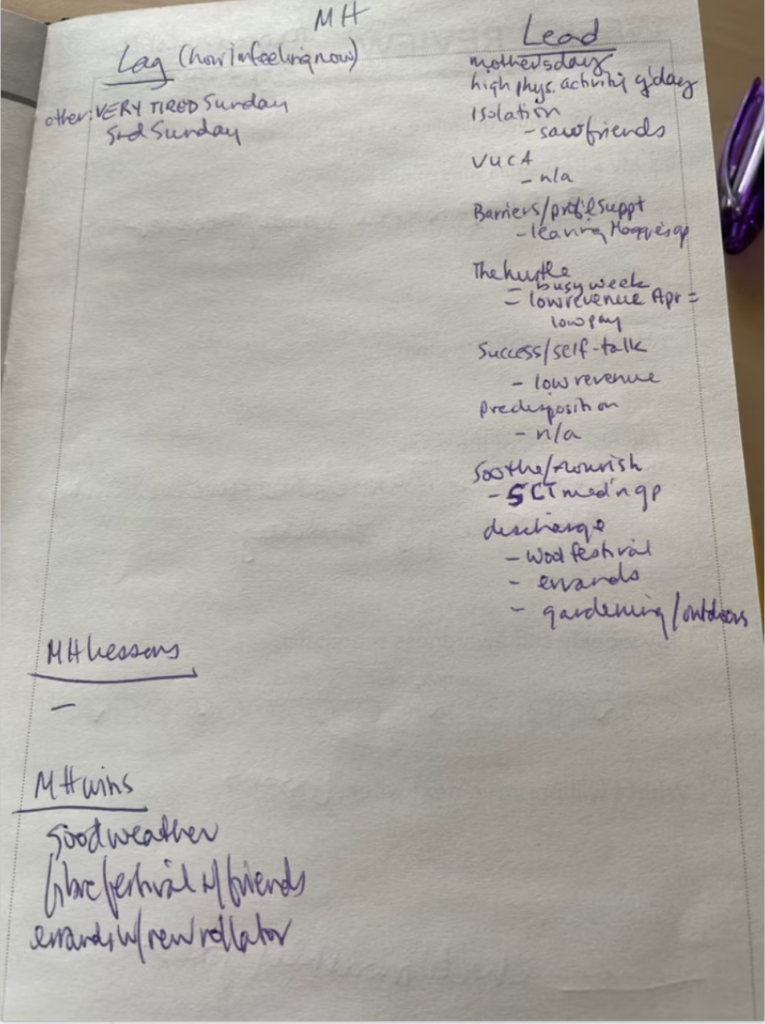
How I conducted my review
In this very analog review, I noted my lag indicators.
On a weekly basis, I conduct a review of my business goals and performance, and I make plans for the coming week. The mental health and business plan review can just be five or 10 minutes incorporated into your regular weekly review of your business goals and performance.
As part of that, I looked at how I’m doing and I looked at the seven factors and how they had an impact on me this week. And you can see my soothe, discharge and nourish at the bottom. The tactics I engaged in this past week, I looked at whether they worked and didn’t work. I call that lessons and wins. In this particular week, there was nothing that didn’t really work, and you can see where I noted my wins. I call lessons wins because I like to celebrate.
You’ll also notice that I didn’t put my plan on this page. You can easily note down the to-dos that you need to put on your calendar and in your project management software. You can note them here to remind you to put them there, but I usually like to put them in the calendar and in my project management software right away. I prefer not to double up and enter them twice, once here on my review page and then again in my project management software or calendar so they’ll actually get done..
I assessed how I’m doing (IOW my lag indicators). You can see on this picture of my analog version, I review and note what worked and what didn’t. I looked at both my lag and lead indicators.
I planned for the support I’ll need for the week based on my assessment and on the conditions that I know are coming up, like the things I have on my calendar for this week.
For example, if my assessment showed that I’m tired and needing sleep, I’ll plan for better sleep hygiene this week. If my lead indicators for the coming week included a couple of really long days, I’m going to make sure I have fast and easy food available for those days. I also have rest time booked for the weekend coming up.
I have separate sheets on which I’ve listed my usual lag and lead indicators. I review and update those from time to time.
Most of the heavy lifting in my mental health plan and business planning is done once a quarter. So, the weekly reviews only take a short time. In a week when I don’t have much time, I’ll take 10 minutes, and when I have more time to reflect, I’ll take an hour sometimes, and do a bit of journaling along with the rest of the weekly review.
If you want to learn more about working with me on an ongoing basis so you can set the foundation for sustainable success in business and show up as the CEO you want to be (as well as the spouse, parent, family member or friend you want to be),click here to schedule a free call.